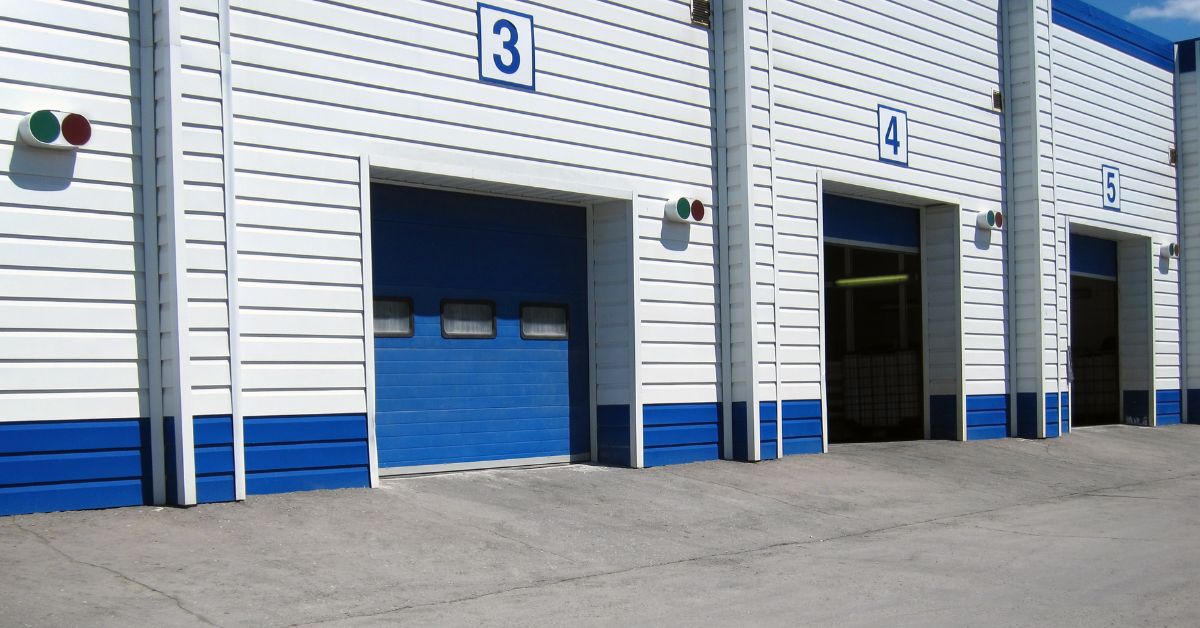
Certain upgrades for your business feel like a luxury, and others feel like an absolute necessity. When you’re looking at the big, heavy overhead doors in your loading dock or warehouse, automating them might seem like something that’s simply nice to have rather than a must-have. After all, manual doors have worked just fine for decades, right?
But as any business owner knows, “just fine” isn’t always good enough when efficiency and safety are on the line. The physical strain on your team, the time lost during transitions, and the potential for accidents with manual operation are real concerns that don’t always show up on a spreadsheet until something goes wrong.
You want to make sure every dollar you spend brings value back to your company. So, does automating your overhead doors actually make sense for you? Let’s walk through the factors that matter most.
The Hidden Costs of Manual Operation
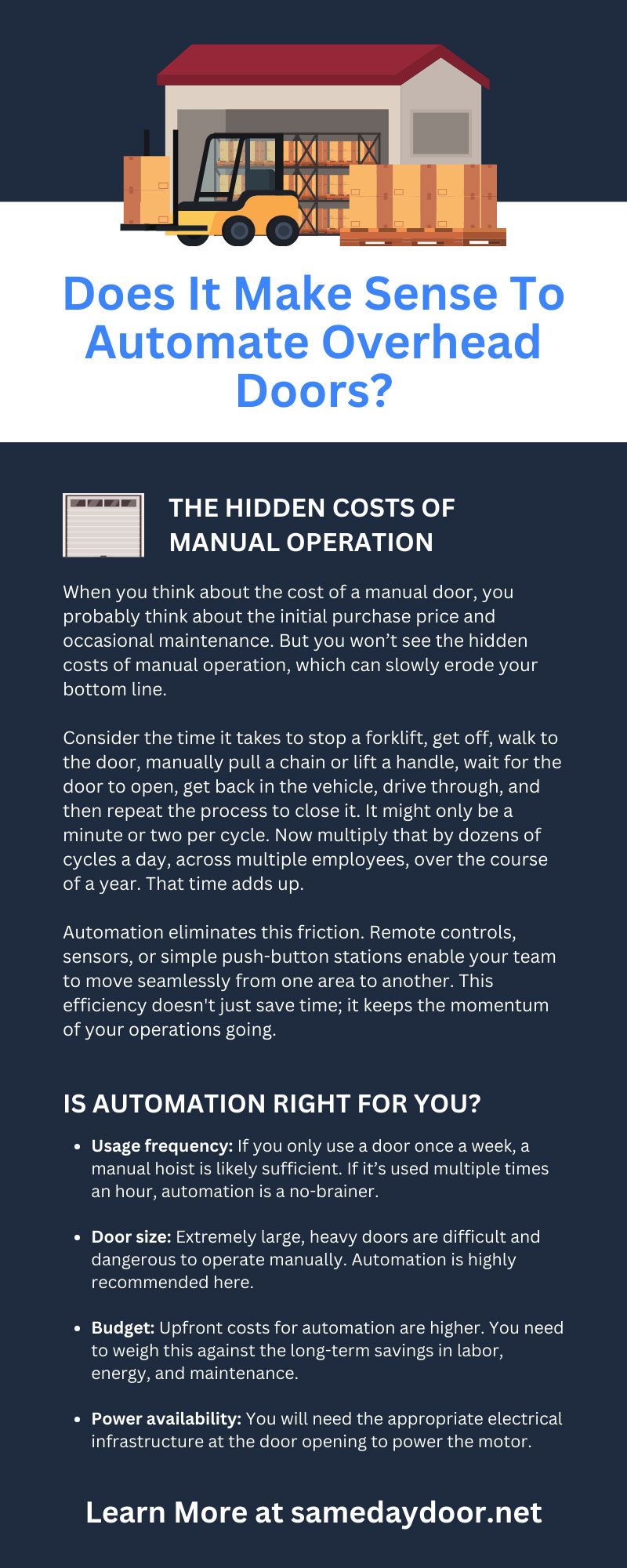
When you think about the cost of a manual door, you probably think about the initial purchase price and occasional maintenance. But you won’t see the hidden costs of manual operation, which can slowly erode your bottom line.
Consider the time it takes to stop a forklift, get off, walk to the door, manually pull a chain or lift a handle, wait for the door to open, get back in the vehicle, drive through, and then repeat the process to close it. It might only be a minute or two per cycle. Now multiply that by dozens of cycles a day, across multiple employees, over the course of a year. That time adds up.
Automation eliminates this friction. Remote controls, sensors, or simple push-button stations enable your team to move seamlessly from one area to another. This efficiency doesn’t just save time; it keeps the momentum of your operations going.
Prioritizing Safety for Your Team
We know how much you care about your crew. They are the heartbeat of your business. Unfortunately, manual overhead doors are a common source of workplace injuries. Back strain from repetitive pulling, pinched fingers, or more serious accidents caused by doors closing unexpectedly can occur with manual systems.
Automating your doors is a direct investment in your team’s physical well-being. Automated systems come with advanced safety features that manual doors simply can’t match, such as:
- Photo eyes and sensors: These detect obstructions in the doorway. If a person or vehicle is in the way, the door won’t close. It stops and reverses, preventing crushing accidents.
- Controlled speeds: Automated doors move at a consistent, safe speed, eliminating the risk of a door slamming due to operator error or mechanical failure.
- Reduced physical strain: By removing the need to manually lift or pull heavy doors, you significantly reduce the risk of musculoskeletal injuries among your staff.
When your employees feel safe and aren’t worn out by physical labor, morale improves, and productivity naturally follows.
Energy Efficiency and Environmental Control
If you run a facility that requires climate control—whether it’s keeping heat in during winter or maintaining cool air for food storage—an open door is your enemy. Manual doors tend to be left open longer than necessary; it’s human nature. If it’s a hassle to open and close the door, an employee is more likely to leave it open on multiple trips.
Automated doors solve this through programmable timers and rapid operating speeds. You can set the door to close automatically after a specific number of seconds, ensuring it’s never left open by mistake. High-speed automated doors open and shut in seconds, minimizing the air exchange between your facility and the outside world.
This tight control over your environment can lead to significant savings on energy bills. Plus, it helps keep out dust, pests, and debris, protecting your inventory and equipment.
Security and Access Control
How easy is it for an unauthorized person to open your manual warehouse door? Often, the answer is, “Too easy.” Employees or managers can forget manual locks, or keys can be lost or copied.
Automation brings a new level of security to your facility. You can integrate modern operators with access control systems that require keycards, codes, or even biometric scans to operate. This ensures that only authorized personnel can open the doors.
Furthermore, because automated doors are harder to force open from the outside when closed, they act as a stronger deterrent against theft and vandalism. You gain peace of mind knowing your facility is secure, even when you aren’t there.
Durability and Maintenance
It sounds counterintuitive. Wouldn’t a more complex machine require more maintenance? In reality, automated doors often suffer less wear and tear than manual ones.
Manual operation is inconsistent. One employee might rip the chain down with force, while another pushes the door up too hard, causing it to slam into the stops. This inconsistent handling stresses the cables, springs, and tracks.
Automated openers provide a smooth, consistent motion every single time. Soft start and stop features gently ramp the speed up and down, reducing shock on the door’s mechanical components. While the motor itself will require maintenance, the door hardware often lasts longer because it isn’t subjected to rough manual handling.
Is Automation Right for You?
While the benefits are clear, automation isn’t the answer for every single door in every single building. Here is a quick checklist to help you decide if it makes sense for your specific situation:
- Usage frequency: If you only use a door once a week, a manual hoist is likely sufficient. If it’s used multiple times an hour, automation is a no-brainer.
- Door size: Extremely large, heavy doors are difficult and dangerous to operate manually. Automation is highly recommended here.
- Budget: Upfront costs for automation are higher. You need to weigh this against the long-term savings in labor, energy, and maintenance.
- Power availability: You will need the appropriate electrical infrastructure at the door opening to power the motor.
Making the Switch
Deciding if automated overhead doors are worth it is a big decision, but you don’t have to do it alone. If you’re unsure which type of operator you need, or whether your current doors are compatible with automation, we are here to help.
Same Day Door Service offers commercial overhead door repairs along with other services. We can help provide repairs to recently automated doors or install your new doors quickly and efficiently.
Your business deserves to run smoothly, and your team deserves to work safely. If automated doors can help you achieve that, it’s an investment worth making.